Putin's Propaganda Machine by Marcel H. Van Herpen
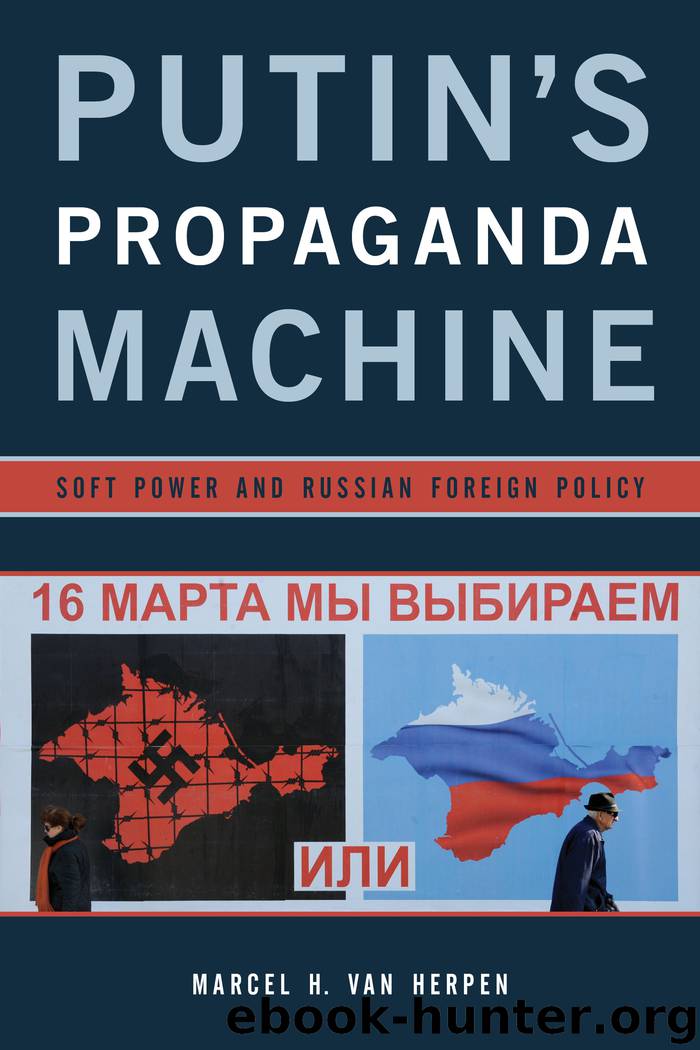
Author:Marcel H. Van Herpen
Language: eng
Format: epub
Tags: undefined
Publisher: Rowman & Littlefield Publishers
Published: 2012-09-09T04:00:00+00:00
The Formation of “Street Missionaries” in Russia
To be able to launch such a huge missionary effort, it is not enough for the Kremlin and the ROC to simply supply money and take over Orthodox diaspora communities abroad. It also implies the necessity for personnel to sustain these ambitious missionary efforts. Certainly, a rising number of Russian citizens identify themselves as Orthodox. According to polls conducted by the independent Moscow-based Levada Center, in 2008 71 percent of the respondents called themselves “Orthodox.” This compares with 69 percent in 2007, 60 percent in 2004, and 59 percent in 2003.[47] These figures suggest that “a revival in religious convictions has occurred among the younger generation in the region, especially in Russia, although . . . this has not, as yet, been accompanied by a rise in church attendance.”[48] The reason for this low church attendance is that Orthodoxy has become for most Russians more a question of national and ethnic identity than of genuine religiosity. This is confirmed by sociological research, which observed in Russia the rise of a “pro-Orthodox consensus,” making the Orthodox Church the most trusted institution in the country—above the army, the government, the parliament, and the political parties.[49] “This means that for many Russians today it is possible to be an adherent of a certain faith without being a believer. . . . In fact, many nonbelievers are ‘Orthodox’, and even atheists can claim the same, like Belarusian president A. Lukashenko: ‘I am an Orthodox atheist.’”[50]
Estimates say that only a meager 5 percent of self-confessed believers are regular churchgoers.[51] This was the reason that in December 2009 Patriarch Kirill launched a nationwide mission campaign. The Patriarchate started to finance and organize “formation courses for mission on the streets among the young people, promoting Christian values against the ‘Western philosophy’ of drugs, egotism and moral relativism.”[52] In May 2010 the first hundred young adults attended the course. This “army” of missionary specialists was “ready to reconnect young people to religion.” The missionaries would create youth groups throughout the Russian Federation. What differentiates the new group from the Orthodox Youth, existing since 1991, is that “it is intended to promote, together with religious values, an ‘anti-Western philosophy’, politics and patriotism.”[53] It is easy to recognize here the political agenda of the Nashi, Putin’s youth movement. It was, therefore, no surprise that in June 2010, the new group of Orthodox missionaries made its first appearance at the summer camp of this pro-Kremlin movement. Boris Yakemenko, the leader of the Orthodox wing of the Nashi, was tasked with preparing them to be trained to “street missionary activity.”
Download
This site does not store any files on its server. We only index and link to content provided by other sites. Please contact the content providers to delete copyright contents if any and email us, we'll remove relevant links or contents immediately.
| Anthropology | Archaeology |
| Philosophy | Politics & Government |
| Social Sciences | Sociology |
| Women's Studies |
The Secret History by Donna Tartt(19466)
The Social Justice Warrior Handbook by Lisa De Pasquale(12291)
Thirteen Reasons Why by Jay Asher(9110)
This Is How You Lose Her by Junot Diaz(7054)
Weapons of Math Destruction by Cathy O'Neil(6465)
Zero to One by Peter Thiel(5944)
Beartown by Fredrik Backman(5928)
The Myth of the Strong Leader by Archie Brown(5623)
The Fire Next Time by James Baldwin(5579)
How Democracies Die by Steven Levitsky & Daniel Ziblatt(5321)
Promise Me, Dad by Joe Biden(5228)
Stone's Rules by Roger Stone(5185)
A Higher Loyalty: Truth, Lies, and Leadership by James Comey(5082)
100 Deadly Skills by Clint Emerson(5023)
Rise and Kill First by Ronen Bergman(4890)
Secrecy World by Jake Bernstein(4871)
The David Icke Guide to the Global Conspiracy (and how to end it) by David Icke(4842)
The Doomsday Machine by Daniel Ellsberg(4618)
The Farm by Tom Rob Smith(4605)
